Caffeine: the most potent artificial intelligence drink!

Caffeine: the most potent artificial intelligence drink!
Deep in the Lair of the Perpetually Curious Fox

Wednesday, 16 July 2014

Dandelion (Taraxacum officinale)

I finally managed to remember to take some photos of Dandelion to put in the list. This is probably the only edible wild herb that anyone, even a child, can identify easily. These are dandelions growing wild around the garden plot. And since the area has been designated for crops and tested for heavy metals, I am pretty confident it is safe to harvest and eat.

Picked a medium sized bunch (maybe 100 g) of younger leaves from the centre of the rosette. Older ones, especially from plants that has already flowered tend to be more bitter. Some people "pre-blanch" them while growing by placing upturned pots over the growing plants. I have tried them raw, and found them too bitter for me (delicious, but bitter!) so this time round I will try cooking them.

Nutrition-wise, you cannot go wrong with Mr Dandelion. Much detested by people who like orderly lawns and well behaved garden, much loved by Wild Food enthusiasts for it's food value. Again, we see this table of nice information on the nutritional data of raw dandelion leaves:

Dandelion greens, raw
Nutritional value per 100 g (3.5 oz)
Energy 188 kJ (45 kcal)

9.2 g
Sugars 0.71 g
Dietary fiber 3.5 g

0.7 g

2.7 g

Vitamins
Vitamin A equiv.
(64%)
508 μg
(54%)
5854 μg
13610 μg
Thiamine (B1)
(17%)
0.19 mg
Riboflavin (B2)
(22%)
0.26 mg
Niacin (B3)
(5%)
0.806 mg
(2%)
0.084 mg
Vitamin B6
(19%)
0.251 mg
Folate (B9)
(7%)
27 μg
Choline
(7%)
35.3 mg
Vitamin C
(42%)
35 mg
Vitamin E
(23%)
3.44 mg
Vitamin K
(741%)
778.4 μg

Trace metals
Calcium
(19%)
187 mg
Iron
(24%)
3.1 mg
Magnesium
(10%)
36 mg
Manganese
(16%)
0.342 mg
Phosphorus
(9%)
66 mg
Potassium
(8%)
397 mg
Sodium
(5%)
76 mg
Zinc
(4%)
0.41 mg

Other constituents
Water 85.6 g

Percentages are roughly approximated using US recommendations for adults.
Source: USDA Nutrient Database

It is also a known diuretic, and helps your liver and kidneys flush out the toxins. Like it's cousin, Milk Thistle, it is said to have beneficial effects to detoxifying your liver. Caution should be taken for those of you who take prescription medications, as it can affect the serum concentration of the drugs in your blood, due to the diuretic effect, and liver stimulating properties. Be sensible, and not eat big bunches of Dandelion too regularly if you're reliant of medication, eh?

Now, the leaves were washed and finely chopped. I don't bother removing the midrib of the leaves, either. Into the frying pan with olive oil and garlic, with a handful of Nasturtium (Trapoleum majus) leaves to give it a peppery bite, and a handful of chards to mellow out the bitterness .... Saute until wilted (3 minutes or so), a little bit of salt, and serve.

And here's dinner! Dandelion greens, with Nasturtium and Chards, on rice, with some baked, wild salmon! Omnomnom! Guess what? I think I really like having Dandelion prepared this way, it tastes like very strong mustard greens, with a hint of pleasant bitterness that goes really well with garlic. Will harvest some more tomorrow and freeze a few portions so I can have some in winter!

Free vegetables. What's not to like?
The flowers are mostly gone and Clocked out, but for sure the flowers are edible, too. Not to mention sweeter than the leaves.

On a tangent, I'm glad that Dandelion has inspired some fantastic works of art:

Robin Wright's Faeries with Dandelion Blowing in the Wind

Saturday, 12 July 2014

Shepherd's Purse: Capsella bursa-pastoris

               
Shepherd's Purse is not really a vegetable plant as such. More like a medicinal one, as it was used a lot as a remedy for bleeding problems, internal and external, due to it's styptic effect. The tea is also used for menstrual problems, like heavy bleeding. Pregnant women should avoid using this as it promotes uterine contractions. In the far east the seeds are and plant are used in various local traditional dishes.

Supposedly, if you burn this plant (presumably, dried first), the ashes can be used as salt substitute. Maybe if I can find a patch not so close to the roads, I'll try it out to see if it's true.

It also has antiseptic properties, acts effectively against gram positive bacteria, and has been used as a quinine substitute. With the advent of modern, industrially produced medicines, the usage of this plant has dropped, and what was once a valuable medicinal plant has now been relegated to "weeds" to most people in the western world. Good thing it is still a popular traditional food in Asia. Maybe it will make a come back, maybe as an antibiotic substitute, as the numbers of antibiotic resistant pathogens seems to be on the rise. I wonder if this humble plant can work on MRSA?

Pinnate Tansy Mustard: Descurainia pinnata


Pinnate Tansy Mustard looks very much like the Pineapple Weed previously mentioned, except that the leaves are more feathered with symmetrical branching look, unlike the PW which has more carrot-leaf look to it.

Yes it is edible, much like any mustard greens (no I haven't tried it, being the side of the street plant). Another cousin of it looks similar, Flixweed, which is an introduced species from Europe. Tansy Mustard is native to North America.

The seeds were used by the native North Americans as food, and has been traded prior to the introduction of modern grains, like wheat. It is, however, toxic to livestock, which is why this plant is not very popular with farmers.

Perennial Sow Thistle: Sonchus arvensis (close cousin of Dandelion)


You'd be forgiven to initially think this is a Dandelion plant, I certainly did, but it's not. It's actually the Perennial Sow Thistle. They are, however, very closely related, and like Dandelions, the leaves and flowers are edible. Although, to me, the leaves of both species are too bitter to be eaten raw. Cooking it probably would taste better. The flowers are fine, though. Very sweet, in fact, and people actually do make Dandelion Wine -- I would imagine it would work well with Sow Thistle.

When we lived in Calgary I'd just pick a few leaves and flowers now and then from the side of the house, where I know they are not sprayed with pesticide or flavoured by dog turds XD. Here, because of the sheer number of dogs and lazy owners who don't pick up after their 4 legged friends, I just give them a sad glance and not bother harvesting. I did pick this one sample to take photos off, and to press. Not for eating, definitely not.


I have actually seen (Organic) Dandelion leaves being sold in Up Market Wholefood Shops, no surprise as it is very nutritious. Our Old Friend Wikipedia supplies these details:
Dandelion greens, raw
Nutritional value per 100 g (3.5 oz)
Energy 188 kJ (45 kcal)

9.2 g
Sugars 0.71 g
Dietary fiber 3.5 g

0.7 g

2.7 g

Vitamins
Vitamin A equiv.
(64%)
508 μg
(54%)
5854 μg
13610 μg
Thiamine (B1)
(17%)
0.19 mg
Riboflavin (B2)
(22%)
0.26 mg
Niacin (B3)
(5%)
0.806 mg
(2%)
0.084 mg
Vitamin B6
(19%)
0.251 mg
Folate (B9)
(7%)
27 μg
Choline
(7%)
35.3 mg
Vitamin C
(42%)
35 mg
Vitamin E
(23%)
3.44 mg
Vitamin K
(741%)
778.4 μg

Trace metals
Calcium
(19%)
187 mg
Iron
(24%)
3.1 mg
Magnesium
(10%)
36 mg
Manganese
(16%)
0.342 mg
Phosphorus
(9%)
66 mg
Potassium
(8%)
397 mg
Sodium
(5%)
76 mg
Zinc
(4%)
0.41 mg

The leaves on the flowering stalk confused me a little initially. But the Basal leaves are very Dandelion-like, but with fine teethy edges. I'll try to take some photos tomorrow


Personally, I think paying for Dandelion (and ilk) leaves or flowers is a little bit daft. But that's just me, hey.


Friday, 11 July 2014

Pineapple Weed aka Wild Chamomile, Matricaria discoidea


Next plant on the list is a plant that is native to North America, but is considered a pest in Europe. The Pineapple Weed is also known as Wild Chamomile, and yes, it is related to the Chamomile used as teas, although the flowers looked more like a petal-less chamomile flower. 

The name Pineapple Weed came from the fact that the flowers, when crushed, exudes a Pineapple aroma (stronger smell if the flowers are harvested in the morning). The leaves, when crushed, at least to me, smelt like the Chamomile tea sachets that I have in the kitchen.

Just like it's European counterpart, you can make tea with the flowers, and the result is a very mild and relaxing tea. Some people also eat the leaves in their salad, but it is a bit bitter. Of course the flower heads are edible, too.

However, try not to confuse the Pineapple Weed with wild Pinnate-Tansy mustard! The other plant, while edible, too, has a mustardy taste (thus Mustardy Tea). They look very similar when in leaf, as you can see below. Can you tell the difference between a sprig of Pinnate Tansy Mustard and Pineapple Weed?


Look closer, the Pineapple Weed is on the left, and Pinnate Tansy Mustard is on the right. The Pineapple Weed has more "carrot leaves" appearence, while the Mustard leaves has a definite "feathered" and symmetry to it. Of course, the flowers are different. When harvesting or just identifying, crush the leaves between your fingers. Pineapple Weed smells pleasant and fruity, like Pineapple with a hint of citrus, while the Pinnate Tansy Mustard, well, smells like mustard!

Yes, Tansy Mustard is edible, and can be eaten as a potherb, or salad. It's just not good for making teas, LOL.


Thursday, 10 July 2014

Broadleaf Plantain: Plantago major


You cannot go anywhere without seeing this herb, considered a weed by many. This is the Broadleaf Plantain, and believe it or not you have probably seen the seeds (ground up, of course) in lots of drugstore, being sold as laxative. The seeds of the close cousin of this plant is actually the famous Psyllium! You will never look at this as a weed again.

Not only do the seeds of this (and it's many cousins) are used as medicine, the leaves and flowers are also edible. It is an introduced species in North America, sometimes also known as "White Man's Footprints" to some, and "Desert Indian Wheat" (at least the psyllium species is) to others.

In Europe and Asia, where the plants came from originally, they are quite popular leaf vegetable and also used for stomach ailments like IBS, and inflammation of cuts and wounds. The plant has a soothing antibacterial property that made it famous for use as poultices.

I will have to remember to pick some plants the next time I go to my vegetable plot.


Wednesday, 9 July 2014

Fireweed: Chamerion angustifolium


Fireweed (Chamerion angustifolium) always make me think of hunting season, for the reason that I snack on the flowers and shoots a lot when wandering around in the woods looking for deer. They are considered a weed in a city setting as they grow easily and form large clumps in otherwise unvegetated areas, or areas that have had forest fires. Sometimes a whole formerly logged section of a mountain would be covered in meadows of fireweed. The seeds can lie dormant for many years in the ground, until a fire breaks out - they are one of the main colonisers after a fire. Hence the name.

The young shoots and the flowers are also quite sweet when eaten raw, and it has a surprising high content (67%, raw leaves) of sugars. Which was why I snack on them a lot. I call them "deers' Ice Cream" as I'm pretty sure they deer loves to eat them to fatten up before the winter, due to the high sugar content. People also make tea out of the leaves and flowers, either fresh or previously dried.

Not much protein content, compared to Goosefoot, but it has a high mineral content, including calcium and other trace ones like manganese. Higher vitamin C content than Goosefoot, too. Supposedly the high mucilage content is soothing for IBS -- I'll let you know if my GI is behaving well tonight after dinner. It's been bugging me lately.

Bees that make honey from mainly fireweed flowers produces honey that are said to be berry-like and spicy. I've yet to try it, though, but I'll be just as happy chucking some fireweed shoots into my stir-fry for dinner tonight.

These clumps of fireweed are right next to my garden plot. I think I will keep these instead of "weeding them out" as they are attracting a whole bunch of bees - I would love to have them pollinate my tomato flowers!


Edit to add: It seemed that my digestive system really liked having Fireweed and Goosefoot for dinner! I did not have to take any H2 blocker last night, and no resulting GERD symptoms from my spastic GI!

NOTE: Talk to you doctor first before discontinuing any medications. I use H2 blockers in conjunction with H1 antihistamines due to my severe histamine reactions to some food. Part and parcel of the joys of living with Ehlers-Danlos Syndrome complications. I'd like to be able to reduce the amount of H1 and H2 I take daily to give my liver a break once in a while.

Tuesday, 8 July 2014

Goosefoot, Lambs quarters, Chenopodiaceae

Chenopodium album: Goosefoot.
Freshly picked from my garden plot

Shame on me for chucking these away the past 2 weeks, weeding my plot. This is Chenopodium album, aka Goosefoot or Lambs Quarters, one of the more popular edible wild herbs in the past. Not so well known, or popular nowadays, mostly considered an "Ugly Weed" that gets pulled out and chucked into a compost pile.

However, there are signs that this *weed* is making a comeback to our dinner tables. A lot of Wild Food enthusiasts list this plant as one of the top plants to forage for, as a quick google search of Goosefoot Recipes will yield. The common method is to just saute it in olive oil/butter and garlic. WildFoodGirl likened the taste to Spinach, and her recipe has even dedicated Spinach-lovers raving about this Free Food. Delightful! I cannot wait to try it myself!

Obviously be sensible about where you harvest your wild edibles; don't eat those just growing by the side of the street because of possible hydrocarbon contamination from engine exhaust. Also, if you live in a town that has mining heritage, be aware of areas located close to mines and their leachates. Or pick plants from doggy parks, for the presence of foecal coliforms from the Four-Legged tail-waggy by-products.

If it's in your dedicated vegetable patch, areas not close to pollution (man made, and dog made), then by all means go nuts! I'll be weeding again in a couple of days, and hopefully I will have gathered enough to make a decent sized side dish and give my own review.

I'll be looking into investing some time and money into learning more about the local wild edibles available here. There's a website that I've been studying, on the types of Northern Wild Edibles available, which I think would be interesting for you:

Wild Edible Plants of Northwest Territories

The writer also lists different plants for different regions. I would love to be able to do a similar listing for Southeast Asia someday, before the knowledge of "local free food" vanish amongst the fast moving-tech savvy- Selfie obsessed new emergent culture, where in a short mere one generation the wisdom of plants disappears completely. I guess this worry is applicable to all cultures and countries, not just Malaysia.


Notice the leaves looks suspiciously like an imprint of a goose's foot, hence the name. Not too sure about the etymology of Lamb's Quarters. When I find out, I will let you know.
 Once you know what to look for, you start noticing them everywhere, and I really mean EVERYWHERE!

By the side of the road, at the base of a lamp post.
Obviously well fertilised by our four legged friends ....

Next time you go out for walkies, keep an eye out for my new friend, the Goosefoot :) You can have a look at some better photographs of this wonderful plant on this website, as well:

Edible Wild Food: Lamb's QuartersTake note of the recommendation of NOT eating the seeds, due to the saponin content, which can be toxic if ingested in excess. Hopefully I can identify more plants and share them with you in coming posts.

Edited to add:

You can look up the nutritional analysis of this wild dish here:
Nutritional Data of Lamb's Quarters


24% protein by weight is pretty impressive for a plant, as well as the 129 amino acids score. Spinach scored 119, although having a higher protein by weight percentage at 30%.

Monday, 7 July 2014

Evil Plot part III

It's been a busy gardening weeks for me. The plants are getting established and starting to mutate and have insane growth over the past 2 weeks. And with that, comes the endless battle of getting rid of weeds - or rather, not-planted-deliberately-plants.

It's been hot, sunny and smokey (forest fire about 40 km away), with an average of nearly 20 hours direct sunlight reaching the crazy plants in the crazy Evil Plot. It's safe to say that I'm seeing growth that is 2-3 times faster compared to the garden in Calgary. There's something to be said about gardening in the Sub Arctic: what short season we have is made up by the intense sunshine in summer.

Not so much rain, though. I think the garden got an average of 3mm of rain overall in the past 2 weeks. Because of that, I have to make sure that I water them thoroughly every evening, as the soil that was *given* to us in the plot is very sandy, rocky and does not hold water very well, despite the 40 bags of compost and nearly 125 litres of sphagnum moss worked in. However, one must make do with what one has.
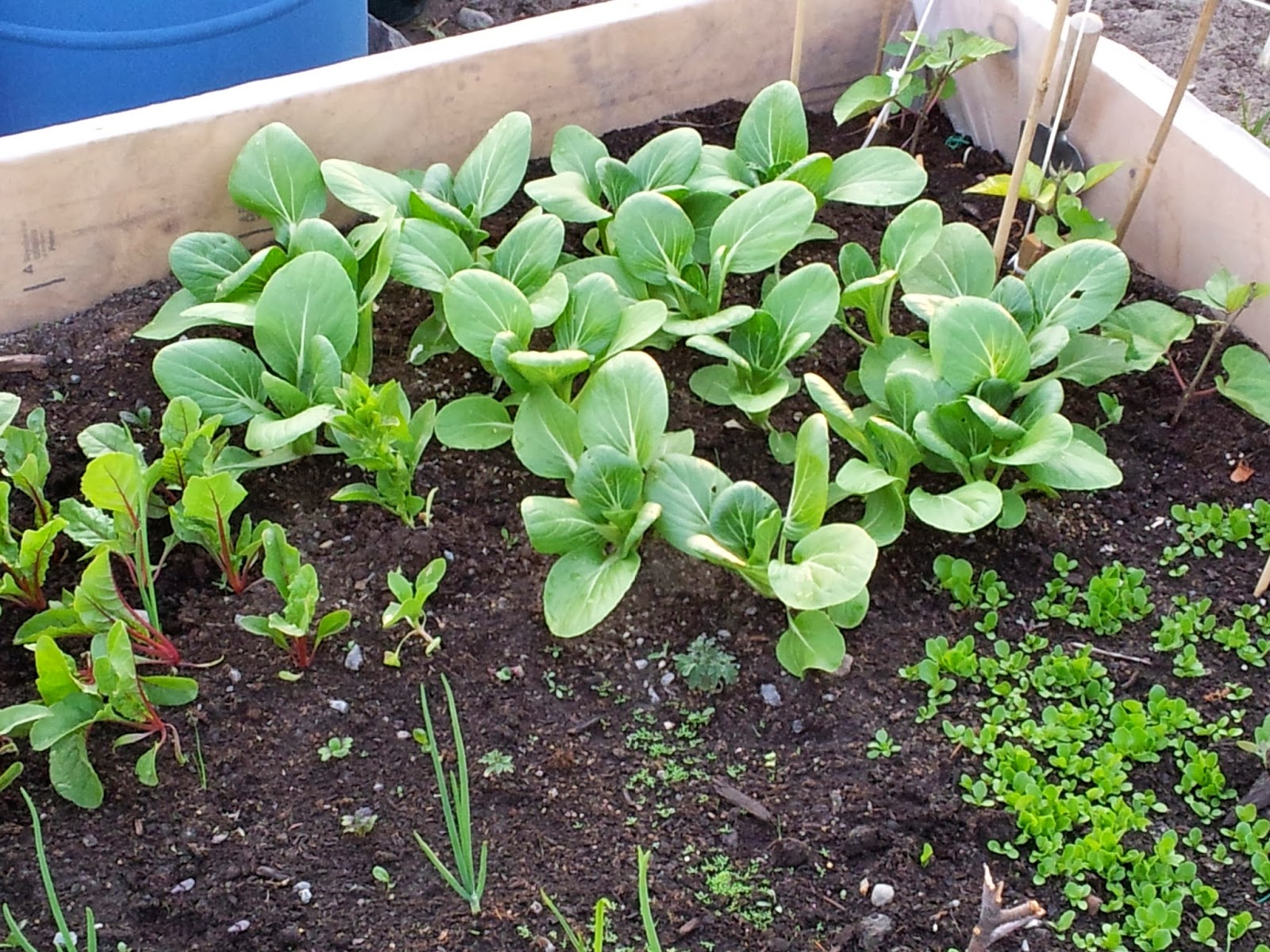
These Bokchoys are only 5 weeks old!


Been harvesting the odd leaves when they are young. Miss me fresh Bokchoys: supermarket ones are fairly tasteless after all the transportation and refrigeration.

The spinach is going nuts, and started to bolt - the intense sun might be triggering the flowering.

Asian Purple Mustard (kinda a mutated purple Boychoy subspecies)

Swiss chards, looking ready for some leaves to be harvested

The Tomato plants are starting to flower!

Dinner is served! All sauteed in olive oil and garlic.
But when it does rain.... the Plants just Exploded! I kid you not! The leaves just widened and lengthened several cm overnight! I guess I can stop buying fresh vegetables at the store with my groceries. That's easily $50-70 per week saved (yes, I spend a LOT for vegetables, they cost an arm and a leg plus your eyes AND ears, up North).

Having some seedlings left over from my egg crate seed starter, I just had to plant them somewhere (no more space in the plot, now that the seedlings have mutated into nearly adult plants). So into pots they go, in the front yard.

A strange mosquito-like insect was on the basil plant. It was orange! Need to get me a Bug Book and see if I can identify some of the insects here. Maybe I'll discover a new species or two.... and will name name the horrible biting ones after certain people that I don't like, and the nicer useful ones after those that I do :p


One of my little Aspie quirk is I can spend hours being mesmerised by something as a drop of water beaded up on a Savoy Cabbage leaf.


The air is so smoky from the forest fire, the sun has a reddish hue, even though it's still a few hours to sunset when I took this photo.

Now, I've been weeding a lot of Chenopodium type seedlings in the past week from the Plot, without realising what they are.... now that I know, they will go into the cooking pot instead of being trampled in the footways.

Duh, me being a Goose, not recognising Goosefoot when it stared at me right on my face XD what a fail for an amateur botanist LOL.

Wednesday, 18 June 2014

Evil Plot part II

Dalek Gardener!


As promised, some more photos of the Evil Plot from my watering today. The tomato (this particular plant is called Mrs. Robinson) has really bad sunburn. Didn't give it enough time to harden before I put it outside full time last week. She's called Mrs. Robinson because she's the first of the batch to "Graduate" to the outside world from inside the indoor nursery.


The pepper plant is also badly burnt. They are showing signs of new leaves forming though, which means they'll pull through.

Too much sun for even the sun-loving peppers!

Carrots are appearing
A whole bag of Mesclun Salad Mix is starting to germinate!

There will be more greens than I'll ever know what to do with. Good thing the local Food Bank accepts donations

A whole crop of peas are poking through. Will need to build a frame
to support the plant in a jiffy before they climb out of the Plot

Onions! Plenty of Onions!

Randomly scattered Amaranth seeds have sprouted over the potato planted in the middle trough.
They will be harvested soon and make way for the potatoes green that will poke out of the soil in a few weeks

This might be more spinach ... will know when the true leaves come out.

Spinach transplanted last week has already bolted! Shocking! Might harvest this tomorrow and plant some chard in it's place

I love Swiss Chards. They taste so much better than spinach, anyways.