Caffeine: the most potent artificial intelligence drink!

Caffeine: the most potent artificial intelligence drink!
Deep in the Lair of the Perpetually Curious Fox

Tuesday, 26 August 2014

Salmonberry (Rubus spectabilis) or Arctic Raspberry (Rubus arcticus)

To be honest, it took me a while to distinguish between the various types of wild Rubus in Alberta. I'm pretty certain that this is Salmonberry, from the look of the foliage and where it was growing (next to a creek, under big pine trees). But I may be wrong! Without knowing what the flower looked like, it can be the Arctic Raspberry, considering the freezing cold of the mountains where this thing grow!


Fun with fungi at Kananaskis Country: Agaricus campestris and Suillus luteus

I love rambling in the woods after a good rainfall in the summer, and see my sporulating friends pop out of the ground. Of course, as with any mushroom/fungi listings, I will include these caveats:

DO NOT CONSUME WILD MUSHROOMS UNLESS YOU KNOW YOUR STUFF!!!!

EVEN EXPERIENCED MUSHROOM PICKERS GET POISONED!!!

SOME POISONOUS FUNGI ARE EATEN BY OTHER CRITTERS THAT HAVE ADAPTED TO THE TOXINS-- ANIMAL BITE MARKS DOES NOT MAKE THEM SAFE TO EAT!!

DO NOT CONSUME MUSHROOMS (EVEN EDIBLE ONES) THAT APPEAR IN CONTAMINATED SITES!! FUNGI ACCUMULATES ENVIRONMENTAL TOXINS!!!
Now that is out of the way, let me introduce you to one of the common summer mushrooms that usually dot the open spaces. At first glance you'll think that this cluster of white mushrooms are like the common supermarket ones. You're partially right. The ones in supermarkets are Button Mushroom (Agaricus bisporus), and these are Meadow Mushrooms (Agaricus campestris).
Agaricus campestries cluster on the ground, out in the open.


Nice sized cap, about 12 cm across

Chocolate gills puts this in the Agaricus genus


It's hard to miss the Agaricus spp, they tend to be white (or off-white to tan) coloured caps, with the characteristic chocolate gills. One particular species, Agaricus arvensis (Horse Mushroom), when picked, have a distinctive Aniseed smell to it when picked. Agaricus subrufescens have almond-like smell to it.

Stay clear of Agaricus that stains yellow, as they can be poisonous to a lot of people (some people can eat them without harm, but don't test this on yourself!). Aptly, the Agaricus xanthodermus is also known by the name "The Yellow Stainer". It looks the same as other Agaricus, except for the yellow staining when cut at the base.

Avoid white mushrooms with white gills. They could be the Death Cap (Amanita phalloides), or the Destroying Angel (Amanita virosa). There is a whole genus of white-gilled mushrooms (Russula), but they have different shapes and growth than the Agaricus group.


Suillus luteus - Slippery Jack - on a bed of bearberry ground cover.
The Suillus genus tend to be common in areas that have lots of pine and larches. Some are known generally as "Larch Boletes", although they are less fat than the rest of the more popular Boletes (which includes the Porcini mushroom). There's a reason why they are called Slippery Jacks, the cap have a slimy, slippery feel to it, and are generally peeled off before cooking (some people can be sensitive to the polysaccharides that gives the slimy feel).

Unlike the Agaricus, turning over the cap will display spongy yellow tissue with pores/tubes rather than gills. The Bolete family all have this pore/tube structure under the cap, which is the identifying trait. The Leccinum family also has this pored structure, but with (usually) white underside of the cap, rather that yellow.


Monday, 28 July 2014

The Evil Plot has gone bonkers

Papaver rhoeas :) Of course, the first one to bloom was pink.

Savoy Cabbage (Brassica oleracea var sabauda)

Roman Chamomile (Chamaemelum nobile)

Flowering stem from a brassica spp from the Mesclun salad mix.

Peas on Earth! Pisum sativum

Flowering stem of Swiss Chard (Beta vulgaris var cicla, and yes they are the same species as beets)

More chamomile

Flowering stem of Potato plant (Solanum tuberosum var Yukon Gold)

Japanese Red Crane kale (Brassica oleracea var Acephala)

Pea flower


Spot the Fibonacci sequence in this pic of Tomato flowering stem!


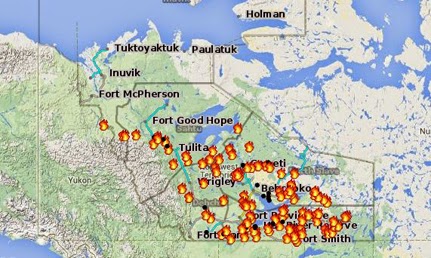
NWT forest fires and resulting smoke.

There's massive forest fires (note the plural) going on in Northern Canada, and the smoke has been torturing our lungs for the past month. It got so bad the only highway going up to Yellowknife from the south was closed for many days, and supplies ran short.


The smoke is even visible from the orbiting satellite! Thick thick smoke....


We went fishing on Saturday to escape the smoke in town, but alas, the lake is thickly engulfed, as well. Both Andrew and I were extremely sick on Sunday from the smoke inhalation. We can hardly see land when out on the lake with the smoke reducing visibility to about 20m or so.


That boat there is about 100m away.
This is what the lake and visibility looks like when the smoke wasn't too thick on the water 2 weeks prior.


Friday, 25 July 2014

Grass-leaved Orache: Atriplex littoralis

I had to wait until the plant flowered before I can be certain of the species. This is Grass-Leaved Orache (Atriplex littoralis) which is another edible wild plant, very popular once, but now has been forgotten.

The leaves of most Orache (or Orach, both spellings are acceptable) usually have a Goose-foot-ey look, which is no surprise, as they are both in the Chenopodioideae subfamily, within the Amaranthacaea  family. In fact, it is the Amaranth-like leaf/flower bract arrangements that cued me that this is the Orache plant. I need to take more close up photos of the leaves, to show the "grass-like" blades of leaves, as opposed to the Goosefoot shape that most orache subspecies have.

As with other uncultivated Amaranthacaea, don't overdo eating the seeds. They have higher quantitiy of saponin, which have surfactant activity (i.e. soap-like). The leaves should be fine. Some species of Oraches are also known as Saltbush, as they can thrive in salty, brackish areas, and retain the salt in their leaves. Hence the name.

Sunday, 20 July 2014

BRB gone fishing


Pikes are good eating, especially if caught in Ice Cold northern lakes.

Melanistic red fox


Wild Alfalfa: Medicago sativa

This Wild Alfalfa is only included here as a reference. Not exactly edible for us, except for the sprouts (in small doses, it can create a lot of problems for people with Autoimmune disorders - so I tend to give this plant a wide berth), but the flowers are important for bees and other pollinators.

I do love alfalfa honey, though.