Caffeine: the most potent artificial intelligence drink!

Caffeine: the most potent artificial intelligence drink!
Deep in the Lair of the Perpetually Curious Fox

Saturday, 5 May 2012

Return of the Triffids

Did I tell you that I've been busy? Been digging up a new vegetable/flower bed in the back garden, bordering and just under the upstairs bedroom balcony/deck. Removed the top grassy layer and piled them in the wheel barrow to go into the would be compost heap that I'll be working on next. 

Dug about a foot deep and was pleasantly surprised at how rich the soil is under the grass. Accidentally chopped up a few worms (sorry, my annelid friends), too, in the process. 

The weather's been pretty wet and spring-like. Wet, cool, overcast. Started a few seeds already in the greenhouse, too, with a small block heater in the bottom-most shelf. While the block heater makes sure the the in-greenhouse temperature is about a balmy 20 deg C during the day, it just barely keeps the 'house about 5 deg at night when it drops down to below freezing. Good 'nuff.
13 feet by 1 foot (or 4 meters by 0.3 meters). Nearly lost a toe in the digging, too! Lucky for presence of footwear,
a big bruised big toe is better than a chopped off big toe any day.


Some Gai Choy, beets, and Chards in the long container at the back. My egg-carton germinator in the foreground.
Various lavandula types in the polystyrene cup, and indoor over-wintered catnip on the left.

50 seedling coconut fibre pots filled with goodies to come!

A randomly buried (by squirrel pop in the hanging basket) sunflower seed making an early wake up
Carrot greenery poking through... didn't start this from seed though, had a carrot top from dinner prep that I figured
would be worth trying to grow ...

I would guess from the colour of the seedlings, they are the beets.

Gai Choy seedling

Last years Red Amaranth (Amaranthus cruentus) seeds germinated just fine, and surprisingly, when it's not even 10 deg C most days.
Whole bunch of Tropaeolum majus seeds being tucked into old cardboard  TP rolls germinator ...

The Aquilegia rhizomes already sent out new foliage in from the mulched down beds ...

Supposed to Aquilegia seedlings, but is it just me or does it look very Brassica-ish? I'm getting a bit worried now!
Identity crisis plants!

More Brassica-ish Aquilegia seedlings. Oh well, lots of cabbages for us then! Must be seed packet labelling error. 
Random dried pea that I picked up from the pet food supply shop germinated fine indoors, but is a bit ratty looking now when being left outside (after hardening off). It shares the pot with another chestnut seedling.

Good to see the lily bulbs I buried under the spruce tree (inside the pot) made it through winter OK!

Mesclun salad seed mix ...out of 10 seeds scattered onto the pot's surface a month ago only two seedlings tolerated the temperature swings outside. The tall leafy one near the right corner is actually a random kidney bean that I pushed into the soil just for giggles. Never thought it would sprout out just nice in the cold weather!
After overwintering indoors for 5 months, the miniature rose (Rosa chinensis) is soooo glad to come out into real sunlight!
Starts sending out profusion of new well formed leaves within days of being out.

Yeaaa Nepeta cataria (catnip) looks a bit ratty and leggy but they'll bounce
back after I pinch the sickly looking indoor leaves off.

Wednesday, 2 May 2012

Random writings. Or ramblings.


Sorry folks, been busy prepping the garden for the cold weather veg. Will update with the plant log and growth pics when I can find the camera again! In the meantime, have a dose of Fiction.


The Wisdom of the River


I stood by the river. It has just stopped raining. The banks are flooded, and the leaves on the trees barely gripping on the steep bank scattered around me, like drops of glass in the blowing wind. I slid down a few steps, barely out of reach of the frigid flow, clinging to the stunted branches of the treelets that are climbing the steep slope. The air smelt like crispness of spring and the dampness of earth slowly waking up; the sleepy plants sending out tentative shoots to drink the long awaited warmth and light of the Brother Sun, who emerged shyly from behind the dancing Cloud People.

The Elder Sister Wind changed direction suddenly, and instead of the perfume of new growth, came the icy smell of snowmelt and dank, rotting, wood and leaves, from the rivulets that jumped and danced down the rocky face of the Great Stone Pillars that holds up the Sky. What moments before seemed like promise of life, now seemed like the foreboding of Death to come.

But the river still flowed, regardless of the smell of Death and Decay. Slowy, the running, dancing rivulets of water pushed off the pile rotting dank vegetation into the river, who swallowed it whole then spat it back out into the waiting roots of the trees climbing the steep bank. Then I noticed, the steep bank that is mostly rock and gravel is being nourished by the gradual trapping of rotting winter vegetation that comes down with the spring rivulets. From which sprang the climbing trees, whose spindly branches I now held in my cold, numb, hand. The stunted growth is exploding with tightly wrapped summer buds, just waiting to emerge. The promise of Life and Hope, from the wreckage of Death and Decay.

I understood now, why the River calls to me.


Friday, 13 April 2012

Glass bottle end knapping

I've always been fascinated by the various types of tools and blades that can be made out of various types stone; flint, chert, obsidian, agate etc

As a kid I used to collect a whole bunch of flint, granite, quartzite cobbles (hidden in a side pocket of my schoolbag -- yea I was a weird kid) with the intent of knapping them into some prehistoric tools; but alas, one could not easily learn knapping just by reading it in books. Spent years trying to figure out what they meant by "pressure flaking","notching", "billeting tool", and all other terms in the pre-interwebz years. All I've managed to make so far those days are a bunch of crude looking "hammerstone" cobbles, the odd "hollowed out stone beads" and plenty of powdered rock, bleeding fingers, and going "uh oh, that didn't work!"

Oh the great joys of Google and Youtube has finally satisfied me with the "pre-requisite" technique details that the childhood me have hungered all these years!

The problem now is, in Western Canada, flint is not easily available. So I guess I'd start with an easily obtainable material -- the end of a wine bottle -- before I even dream of getting my paws on real flint, chert or obsidian.

Not claiming to be any expert in knapping (disclaimer!) I would direct you to this link

http://cavemanchemistry.com/oldcave/projects/stone/bottle.html

This the most complete "Beginner's Guide" to glass knapping that I've come across (so far). I couldn't figure out who is the actual authors of that article, but whoever you are, you've made this eternally curious fox very grateful!

Now stay tuned for updates on my glass bottle knapping experiment!

In the meantime, if your own curiosity is tweaked and want to start it yourself ... watch this. Thanks practical primitive, for posting the wonderful instructive video!


Wednesday, 11 April 2012

Processing White tail hide into (part III) ... grain off bark tanned leather!


Well folks, after a long while ... I'd say I've finished with the WT hide! Sorry or the long wait, ladies and gents ... spring kinda sprung unexpectedly here and I got busy starting seeds for the vegetable patch!

After about 60-ish days in the tea (I've also added some spruce bark tea to get the more golden highlights and the preservative qualities) the hide was taken out, washed in mild soap (in a washing machine, if you must know!) and rinsed.


Dove body soap (1/3 cupful) with a squirt of betadine surgical scrub.
 Let the hide drip off the excess water, and in the meantime, make yourself some leather mayo. Again, I'm using 1/3 liquid soap and 2/3 olive oil to make 1 cup of leather mayo emulsion.                                    


Just so it can cover the hide, I've diluted it in half a litre of WARM (not hot) water. Work, agitate, pummel, massage, rub, stir, etc for 30 minutes. Kinda wring it the best you can, let it drip off excess dressing, then repeat the work/agitate/pummel again. Then let it sit in the dressing for an hour.


After an hour, take it out of the dressing and let it drip off the excess overnight.


After dressing the hide, I folded it and plonked it in the freezer overnight. Took it out the next day, let thaw outside (8 deg C in the sun that day) let it dry off excess moisture from drippy slippery hide to just damp, and let it freeze outside at night, and prepare to work it the next day.


Even with all the holes and missed grain patches, it looks pretty darn good.
After letting it freeze dry overnight, it still contained a fair amount of water in it. Think of a bath towel after a trip to the swimming pool. Not sopping wet, but it is heavy with moisture. Here's where you'll need a fair amount of OCD ... softening a hide can take upwards of 8 to 12 hours of working it! Of course, you don't have to do it all in one sitting --- roll it up and put in a plastic baggie and into the freezer when you're done for the session.

The hide contains just enough moisture that it WON'T freeze solid - more like a very stiff pair of un-broken jeans. For working the hide, I lashed a canoe paddle onto the deck's steps and used the edge. You can also lace the hide onto a frame and work it with a paddle in your hands -- but I like to be able to rub n' fluff the hide in my palm in between edge working. Plus a hide on a frame won't fit in a freezer all that well .....


Just so I have a quantifiable way to determine the "dryness" of a hide, I weighed it before working, and after working. Once the weight stabilised, it is truly dry! I cannot emphasise how important it is to work the hide till it's completely dry -- most people stop working the hide too soon, and as the fibres dry out (without movement) it'll harden into stiff, plank-like quality! Good rule of thumb is to continue working for another hour when you think you're done ... or until the weight stays constant.

After 2 hours of working ... 1.362 kg


After 6 hours of working .... 0.743kg. Nearly half of it's original weight was water!
After 8 hours of working ... only 3g difference. Yup it's dry. Bear in mind that you also scrape a heck
of a lot of membrane off the hide when you work it ... so you'll lose maybe 2-3 grams of fibres per 2 hours.

Once it's dry, I change technique ... and used a deer scapula for finishing. The way I do it is to sit on half of the hide, lift the edge with my left hand until you have a bit of tension, then use the scapula in my right hand to scrape/fluff the stubborn areas like the back, neck and edges into the softness I want - in this case as soft as a broken in denim fabric feel, as I'm thinking of making a quiver and bow case.


It's funny how well the deer scapula fits in my hand and works so well to fluff up the fibres!  

 
Once you've got the degree of softness you want (of course, if it's still not soft enough, you can always use a spray bottle to re-dampen it and rework), it's time to finish off the flesh side with a pumice stone. Working on an edge kinda make the fibres a bit rough on the flesh side ... so to make it smoother out comes the pumice stone. Drape the hide on your thigh (flesh side up) and rub lightly with pumice stone until it's smooth. Don't over pumice - or you'll make a hole in the hide!


Rough un-pumiced on the top half, smooth silky suedey pumiced on the bottom half.
Yeaa ... I kinda fail at graining the hide because I used a kukri (hence the holes) and missed a few patches on the grain side, but these patches just scrapes off easily with your fingernails after softening ... and kinda adds an interesting character of light coloured patches.

Grain side. Nice golden brown with the odd light tan patches from bad graining.

However, the flesh side looks amazing! Maybe I should finish off the grain side with the pumice stone, too, to even the surface a bit more.

Silky suede smooth!

Soft enough to sew without pre-punching with an awl, yet stiff enough to hold it's shape once sewn into ...
dunno yet. Quiver and bowcase, maybe?
The trimmings are not wasted either. They'll make fantastic ammo or coin pouches. Maybe a deery something for my niece.


So my verdict? For my First Ever Hair Off, Grain Off, Non-Commercial Chemicals Involved Tea Tanning ... definitely do it again. Need a bit more practice in degraining (a proper drawknife would help!) to stop poking so many holes in it ... but yup, B+ for this hide!


Thursday, 22 March 2012

Male Partridges (Perdix perdix) fighting for dominance.

The dominant resident partridge chases the interloper ...

Then does a challenge dance, and initiated a fight when the interloper did not leave!

Monday, 19 March 2012

Interesting spread of readership!

                     Wynken, Blynken, and Nod (Dutch Lullaby)

Wynken, Blynken, and Nod one night
   Sailed off in a wooden shoe---
Sailed on a river of crystal light,
   Into a sea of dew.
"Where are you going, and what do you wish?"
   The old moon asked the three.
"We have come to fish for the herring fish
   That live in this beautiful sea;
   Nets of silver and gold have we!"
   Said Wynken,
       Blynken,
                     And Nod.

The old moon laughed and sang a song,
   As they rocked in the wooden shoe,
And the wind that sped them all night long
   Ruffled the waves of dew.
The little stars were the herring fish
   That lived in that beautiful sea---
"Now cast your nets wherever you wish---
   Never afeard are we";
   So cried the stars to the fishermen three
Wynken,
           Blynken,
                     And Nod.

All night long their nets they threw
   To the stars in the twinkling foam---
Then down from the skies came the wooden shoe,
   Bringing the fishermen home;
'T was all so pretty a sail it seemed
   As if it could not be,
And some folks thought 't was a dream they 'd dreamed
   Of sailing that beautiful sea---
   But I shall name you the fishermen three:
Wynken,
            Blynken,
                     And Nod.

Wynken and Blynken are two little eyes,
   And Nod is a little head,
And the wooden shoe that sailed the skies
   Is a wee one's trundle-bed.
So shut your eyes while mother sings
   Of wonderful sights that be,
And you shall see the beautiful things
   As you rock in the misty sea,
   Where the old shoe rocked the fishermen three:
    Wynken,
             Blynken,
                     And Nod.

by Eugene Field (1850-1895) 


I was just checking the "audience" list for this blog -- am really surprised at the diverse spread of readers.

To my Indonesian readers: Kabare & Selamat Sore

To my Russo readers: Доброе утро

Please feel free to drop in your comments and messages on what you wish to see here. I gotta admit my russian is very rusty (learnt it from a couple of flatmates few years ago) but I do find the language very beautiful. Gotta thank Leo Tolstoi and Fyodor Dostoyevski for introducing me to the russo-world.

As for my Javanese readers, kita serumpun ya. No matter where I go and what I see, I still crave botok-botok, tempe and krupuk belinjau! Kalau ada yang hendak berkenalan, sila poskan sepatah dua kata ... jangan segan jangan silu!

For the North American readers: thanks for dropping by -- I'm still learning about this Continent, the people and the cultures. Pilama yaye!

South Americans: bueno, I hope to visit your corner of the world soon in the future. 

Readers from the old world: I miss the diversity of Europe! Geia sou, merhaba, bonjour, Grüß dich, buenos dias

I suppose I must have inherited the "itchy feet" gene from a very distant ancestor of mine who was a sailor with a portuguese merchant fleet (maybe in the 16th century) who went "native" in South East Asia, and got adopted into a local Minang family. I wonder what stories you would tell, grandfather Bintong, to your descendents who inherited your wanderlust and fierce attraction to the sea, stars and boats!

P.S: Dutch readers, can you send me a link to someone reading the original dutch version of the Poem above?

Friday, 16 March 2012

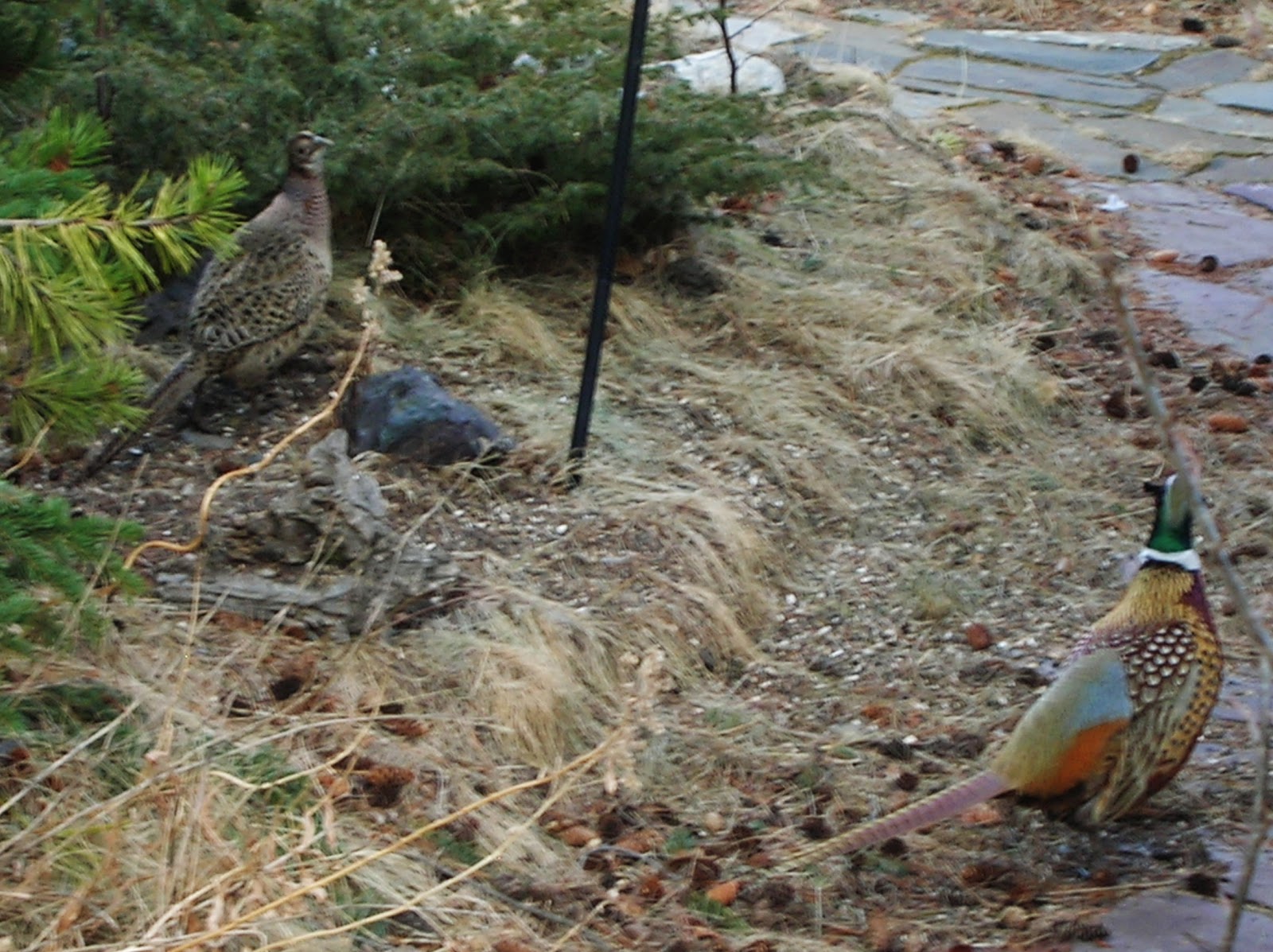
Oh happy joy! The birdies are posing for me!

After a month of trying to get a good photo of them together, Pirate Phil and Liz the Hen has decided to do a courtship dance under the birdfeeder! Methinks a new camera with audio is in the wishlist now ...


The happy pair
And for once, Liz doesn't flutter away from the Pirate's one legged dance. You can see from their postures that they are eyeing each other. Tried to get a video of them dancing, but my 2nd generation 4.0 megapixels Nikon really sucks at capturing it. Nonetheless I give you the feeble offering:

Also got some really good high resolution photos of the pair this time.


Phil is in a terrible fix
His yard's invaded by Perdix perdix
The locals, for fun, call them Atilla (the Hun)
But to me they look more like Obelix!

Thursday, 15 March 2012

Cyanocitta cristata (Blue Jay) and birdies ... and crazy bunnies

They are catching up with the feeding after yesterday's windy spell. It's kinda funny watching a young magpie launch himself clumsily from a rooftop, narrowly missing smacking the side of the house with the gusty winds.


Cyanocitta cristata -- Blue Jay feeding on the millet seeds.
OK, the bird turned to look to his right when the shutter snapped;
so he looks like a weird, beakless, pointy-headed thing here.
It's fascinating watching the bonded pair of Blue Jay reaffirm their bond by feeding each other millet seeds.


Guess who is an avid bird watcher?

Birdies whets his appetite! There's a very good reason he's not allowed out without
his jingly bell collar!
Cardualis pinus (pine siskin) at the feeder
Pica hudsonia (black billed Magpie) feeding

Sunday, 11 March 2012

Yaaarrrrr! One legged mongolian ringneck pheasant rules!

There was once a Pirate Pheasant called Phil
whom as a gamebird is impossible to kill
          "Though a dog chewed one leg,
           I won't whine nor I beg
As long as you keep the birdfeeders filled!"

Now Phil has a hen called Lizzie
He makes her all happy and dizzy
            "I would happily pick
             A popsicle stick
To replace my broken leg gone gimpy"

Then Phil had some strong exchanges
With some philandering Hungarian Partridges
            "They steal all my seeds!
            Lizzie and I need to feed
How I wish I could stuff them all in cages!"

This is a story of courage that can't be killed
The brave one-legged pirate pheasant called Phil
             "Just wait till Liz and I have chicks
              It'll be disgustingly cute and sick"
As he nomnoms on seeds that are spilled


Sometimes when things are not going your way and you get tetchy and annoyed with the world and your painful muscles and joints, problems breathing and sleeping, endless stomach and GI pain, it's always useful to look for lessons to be learnt from Nature.

Phil still hobbles around on his good leg, feeding himself, harassing Lizzie and the partridges in his territory, squawking at Polydactylus and Kato the neighbourhood cats, and generally being a cocky bird (pun intended).


Yes, I'm being followed by a moon shadow
Moon shadow moon shadow
Leaping and hopping on a moonshadow
Moon shadow moon shadow

And if I ever lose my legs
I won't moan and I won't beg
Oh if I ever lose my legs- Oh if...
I won't have to walk no more

And if I ever lose my mouth
All my teeth, north and south
Yes, if I ever lose my mouth- Oh if...
I won't have to talk...

Did it take long to find me
I ask the faithful light
Did it take long to find me
And are you going to stay the night
-- Cat Stevens

Thursday, 8 March 2012

The rise of the Ents ....

Decided that it is the right time to start some seeds for the summer vegetables and herbs.

But first, lets have a look at how some of the indoor, overwintered plants survived.


Dioscorea elephantipes (Hottentot's Bread; Elephant's Foot vine)

It overwintered just fine! Although the growth has slowed greatly over the winter. It still has the same two leaves it had in the summer, but the caudex has swollen appreciably! Hopefully it will vine out more this spring.


Notice the swollen caudex with slight indication of the unique "Elephant foot" scales on the top. Caudex has grown form just under 0.5mm to 0.7mm in the winter. Getting more sun now, hopefully it'll vine out more!
Cereus forbesii spiralis

For some reason, this strain grows faster than the other cacti I have. Starting to show the identifiable characteristic of "spiraling" of the thorn line. I wonder if it'll take anti-clockwise sense.


Crassula ovata (Jade plant) and mutant strain "Gollum"

Crassula ovata is growing happily, but slowly, in the cake container LOL
Gollum fares very well indoors. He has doubled in size since I first got him in July.
Lavandula officianalis/angustifolia (Lavender var English)

I haven't checked to see how his outdoors compatriots overwintered under all the snow ... but the indoor chap has gone to "hibernation" mode. Still alive, but no new growth whatsoever over the winter months.


Rosa chinensis (Miniature rose, angel wings)

I'm surprised at how well this plant over wintered indoors. There's been plenty new growth even under the rather pathetic, inadequate grow lighting. No flowers, but lots of new canes. Slight case of rust though. Need more sun. This particular plant is a weirdo just like me. Eventhough all the canes came from the same seed, each cane produces different coloured roses! Teeny weirdo.

Nepeta cataria (catnip)


Looking really leggy and weedy for now, but it survived the cool basement temperature and inadequate lighting. Hopefully it'll bloom and seed again! The cats love it, the bees bumbles around it, and I love making tea out of the fresh leaves. It's a mint relative, so it is useful ... if you can drink the tea without the cats fighting you for it!


Gymnocalycium mihanivichii spp var friedrichii (moon cactus)

Unfortunately his cousin, var hibotan (orange moon cactus), did not survive the winter. Friedrichii is doing well though. I hope I can induce flowering so I can get some mutant seeds.

Now for the newcomers ...


Mesclun salad mix

Seedlings poking their first sunleaves out of the soil. Mesclun is not a species name, rather, it is a combination of different species in a french style green leaves salad.

Ipomea batatas (sweet potato, ubi keledek, ube jalar)


This plant will always remind me of my grandmother, for she has an endless supply of high quality greens growing in her garden, and prominently the sweet potato bushes and vines. Contrary to local belief, Ipomea batatas is NOT a local of South East Asia but was brought from the South America by traders, and naturalised well in the hot and humid equatorial tropics of Asia.

As the name implies, it is a cousin of the morning glory, and indeed the sweet potato vines are usually sold as ornamental plants ... and the wonderful sweet tubers and nutritious leaves are often ignored by the modern gardener.

Rooting the tuber in a jam jar filled with water. Some new roots have come out!
Hopefully it'll produce some healthy slips to start a hanging vine garden for the swing!
Capsicum frutescens var Scotch Bonnet

I have a fondness for peppers of all sorts. Hopefully these seeds will germinate, flower and fruit before growing season ends.


Friday, 2 March 2012

Listen to the plants sing ...

Image courtesy of scienceblogs.com. Click the link to see more spectacular lightning pics from the Eyjafjallajokull Volcano.


When I was a wee kid, I used to hate it when it rained; as being in Southeast Malaysia the rains are hard, heavy and last for hours, interspersed with continuous thunder and lightning flashes (kilat sabung-menyabung, as the locals would say). It interfered with my play time romping around in the bushes, and it made me a very unhappy kid when it rained.

That is until one day my (late) grandmother saw the disappointment and impatience in my eyes, and she whispered the mystical sentence:

"Don't be hating the rain ... listen to the plants sing instead. They only do so when it rains"

That was maybe 30 years ago. It took me nearly as long to finally make sense of that mystical sentence whispered in the gloomy darkness of a Southeast Asian Thunderstorm, with winds howling through the trees, rain crashing down not unlike waterfalls from the Heavens, and bolts of lightning ripping through the skies, and thunder threatening to strike you dumb with fear.

When the weather is not to your liking (e.g. heavy rain) listen to the plants sing. If you listen, and pay attention, really hard, you can hear it, too. It's not something that I can explain tangibly in writing; it's more of an observational skill, and takes a bit of imagination. But indeed the plants do Sing.

Thank you, Nenek, for the words of Wisdom. I can now hear the plants Sing, and I wish to pass the wisdom to all you readers.